
"Our students will understand today's society though exploring and questioning our history. We want students to use knowledge of the past to empathise with others and play a part in building a positive future for all."
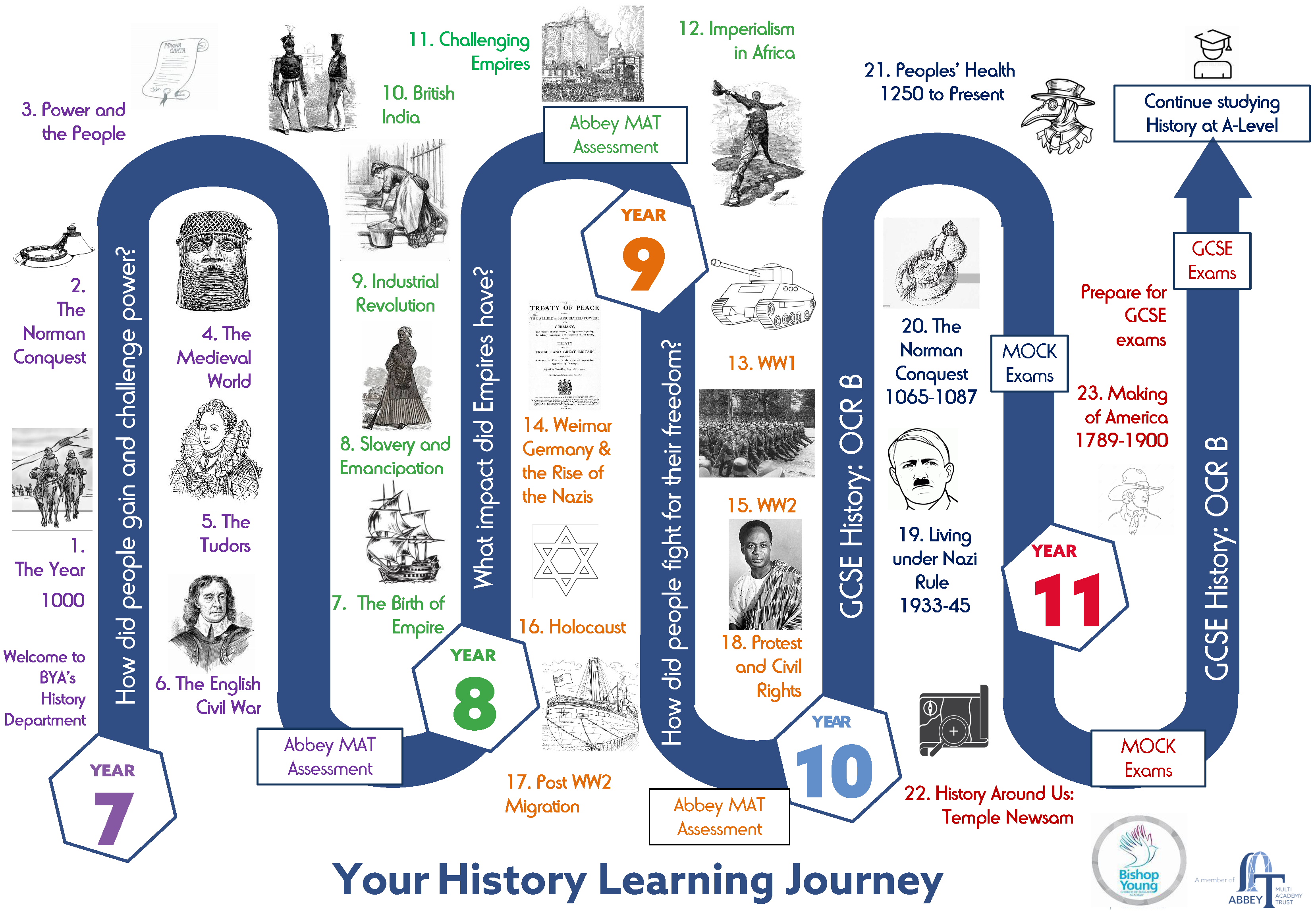
The aim of the History KS3 curriculum at BYA is to ensure all students have the opportunity to explore the past and understand how it influences our culture and values today. Our intent is to ensure that the backgrounds of all pupils are catered for through representation in our curriculum and lessons and that students recognise the diverse and challenging nature of our history. Students will use second order concepts such as cause, change and significance to help to explain the past, and how it is still relevant today. Students will also be assessed at the end of every topic, so that we are best able to understand a student’s strengths and areas for development, and act upon them. We hope all students find History to be an engaging, challenging and thoughtful subject at Bishop Young Academy, and we hope we can inspire students to continue to study History at GCSE level and beyond.
In Year 7, we focus on the theme of power and how people have gained and challenged power between 1000-1700. We start with an examination of the Year 1000 across the globe, studying the rise of the Islamic Empire, the Vikings and the Catholic Church. We then focus on the development of Church, state, and society in Medieval Britain, starting with the famous Norman Conquest of 1066. This allows us to examine the struggle for power in Medieval Britain by investigating historical events such as Magna Carta, highlighting British Values such as democracy and individual liberty. In our fourth topic, we compare how different civilisations rose to power across the globe examining the Mongols and the Mali Empire. Then, we will look at the development of Church, state, and society in Britain 1509-1745. This will include the Tudors and the English Reformation, which connects with our BISHOP characters of perseverance and integrity. Finally, we will also learn about the English Civil War and the development of Parliament.
Topic One: The Year 1000
Topic Two: The Norman Conquest
Topic Three: Power and the People
Topic Four: The Medieval World
Topic Five: The Tudors
Topic Six: The English Civil War
In Year 8, we focus on the theme of Empire and the impact that Empire had on the people they ruled over. We begin by examining the birth of the British, Spanish and Portuguese Empires and look at their impact across the Americas, Africa and Asia. We then move onto ideas, political power, industry, and empire in Britain, 1745-1901. This includes the Transatlantic slave trade, analysing its effects, the consequences, and its eventual abolition. We will also look at the Industrial Revolution, as Britain became the first industrial nation and its impact on society. As we examine Britain’s impact on the world, we will conduct a depth study on British India, and the effect of the British Empire across the world. We will also study how people resisted and fought back against the ideas of Empire in Britain and across the globe through Parliamentary reform and rebellions from enslaved peoples. Finally, we will examine the impact of Empire on Africa and how this would eventually lead to conflict in the 20th Century.
Topic One: The Birth of Empire
Topic Two: Slavery and Emancipation
Topic Three: The Industrial Revolution
Topic Four: British India
Topic Five: Challenging Empires
Topic Six: Imperialism in Africa
In our final year of Key Stage 3, we mostly study historical events of the 20th Century, focusing on the theme of freedom and how people have fought for their freedoms. This means focusing on the challenges for Britain, Europe, and the wider world from 1901 to the present day. We start by looking at World War One, examining the causes and the impact this had on combatants and people around the world. Then, we will move on to focus the inter-war period, looking at the Weimar Government in Germany, and the rise of Hitler, the Nazis and fascism. This will be followed by a study of World War Two, and how civilians at home were affected by the war. Next, we will look at the Holocaust, and the devastating impact genocide had on the Jewish peoples of Europe and all those affected by the horrors inflicted by the Nazis. Then, we will be examining how migration has affected Britain post WW2 and the experiences of those who have migrated to Britain. Finally, we will be studying how people have fought for their freedoms by examining the protests of women, the British Empire and the Civil Rights Movement.
Topic One: World War One
Topic Two: Weimar Germany and the Rise of the Nazis
Topic Three: World War Two
Topic Four: The Holocaust
Topic Five: Post WW2 Migration
Topic Six: Protest and Civil Rights
Students will have an opportunity to study many different types of History, ranging from local, British and world History. They will look at History ranging from the Norman Conquest in 1066 to Modern Britain in the 21st Century. This range of topics and time periods makes this GCSE diverse and exciting for all students.
Component 1: British History
Component 2: History Around Us
Component 3: World History
Component 1: British History – 1 hour and 45 minutes paper (40% of the final exam)
Component 2: History Around Us - 1 hour paper (20% of the final exam)
Component 3: World History – 1 hour and 45 minutes paper (40% of the final exam)
Students could choose to continue with the study of History by taking AS in a Sixth form or at college. The skills learnt at GCSE History will also complement the study of subjects such as English Literature, Politics and Sociology. A GCSE in History shows that you have a high level of literacy and that you are able to analyse complex information. These skills are highly valued by colleges and employers.
Exam Board: OCR


