
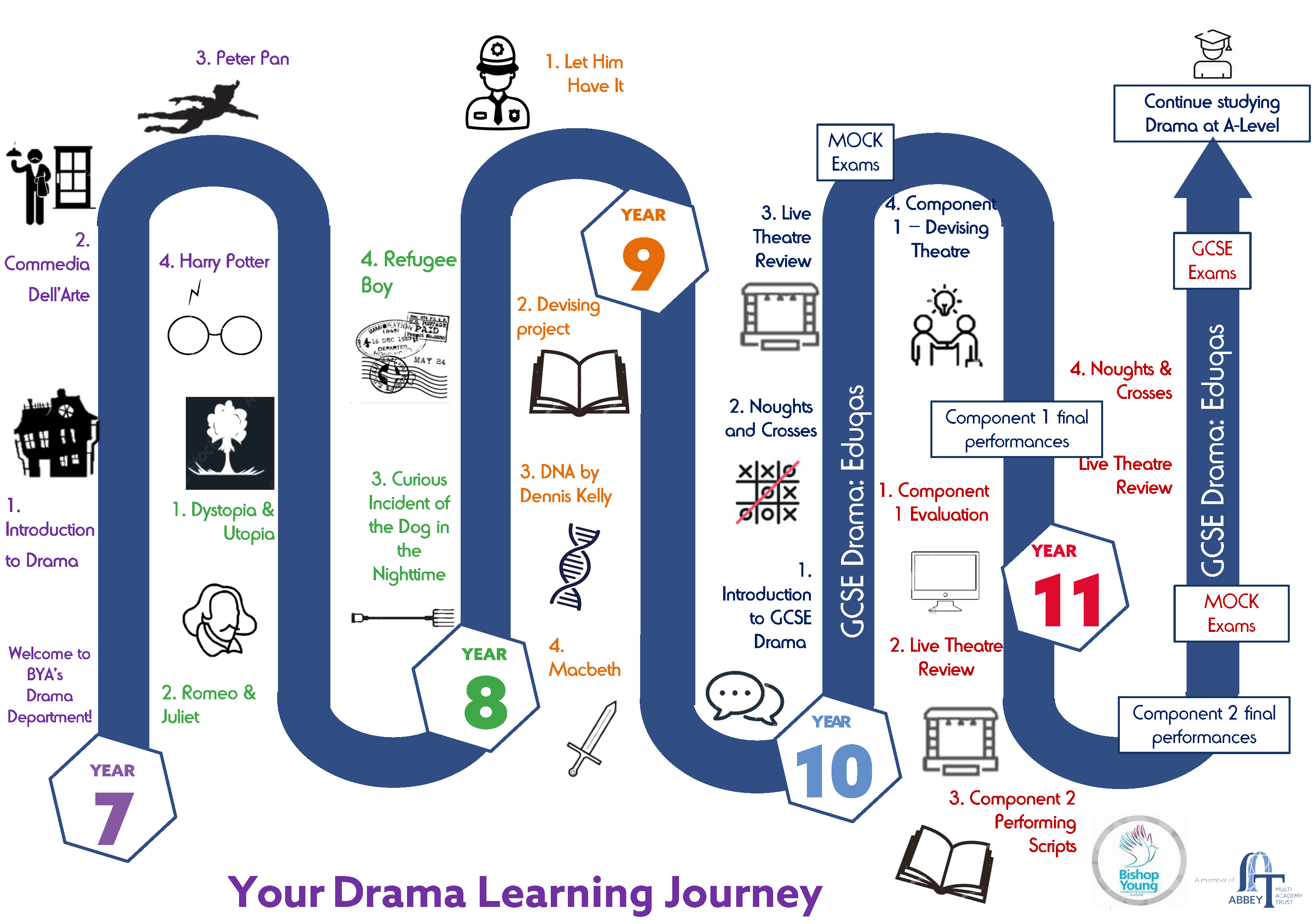
Our KS3 curriculum is designed to build students confidence in handling a range of drama techniques and skills whilst fostering their natural ability for creativity and experimentation. We want our students be ambitious about their ideas and performances, work well with others and develop a lifelong appreciation for the creative arts.
Students will look at a variety of different topics throughout KS3, using key drama techniques and learning how to put them into practice and perform. These topics include comedy, working from a script, devising their own pieces of theatre and storytelling.
Students will undertake a range of different performance styles and will be given the opportunity to perform in many ways. These include, in the classroom, to an invited audience and on camera.
Homework is set each half-term in the student’s Extended Learning Project booklet and will explore the following skills:
• Pre-reading for a new topic
• Researching a genre or practitioner
• Comprehension on the current topic
Students will complete one assessment per topic; three practical assessments and one written assessment. Students will receive regular verbal and written feedback, peer feedback and take part in target setting throughout each topic they work on. In addition, students will frequently be asked to reflect on their learning, highlighting strengths and areas for development.
• Encourage them to join extra-curricular activities and external agencies such as youth theatres in the local area.
• Expose students to as much creativity as possible. This could include; cinema, theatre, dance, opera.
• Attend performances they may be involved in.
• Support with completion of home learning.
Eduqas GCSE Drama
We firmly believe that through involvement in Drama, young people can learn vital life skills such as teamwork, negotiation, problem solving, communication, listening, and can build their confidence and self-esteem.
Through taking GCSE Drama, students who have a love of drama, theatre, performing, shaping performance and an interest in the work that goes on in a production team, can excel in broadening and demonstrating their knowledge and understanding of this vast subject.
Throughout the course students will build on their understanding of drama techniques and how they can be used to explore the drama. They will develop skills in performance by being challenged in new ways, for example looking at the work of established practitioners to find new ways of presenting performance. They will work on both devising performance work and scripted plays, having more time than in KS3 to polish and perfect work, therefore improving.
Students will also develop analysis and evaluation skills, both verbal and written.
Students will be graded using the 1-9 grading criteria.
NB: Although practical assessments are carried out in groups, all grades are given individually to students NOT to the group as a whole.
Non-Exam assessment: internally marked, externally moderated.
You will create a piece of original devised theatre using a choice of stimuli from the exam board. This will be performed and accompanied by a written portfolio and evaluation explaining how your piece was created.
Practical exam assessment: externally assessed by a visiting examiner
You will rehearse and then perform a 10-15 minute piece of scripted theatre from a published play to the visiting examiner with focus on developing character and your stagecraft. There is no written work for this component of the course.
Written examination: 1 hour 30 minutes
You will complete a written exam, answering questions on our set text ‘Noughts & Crosses’ by Malorie Blackman & Sabrina Mahfouz. You will also watch at least two pieces of live theatre in preparation for section B of this exam ‘Live Theatre Review’.
For students wishing to continue their studies in Drama the next step is A Level Drama and Theatre Studies or a BTEC Level 3 Diploma in Performing Arts Acting or Musical Theatre. For pairing with other GCSE subjects, Drama goes well with Languages, History, Religious Studies, English, Media, Law and Music.
Also, due to many of the skills mentioned above, Drama has many transferable skills to aid progression with various education/career choices as it also develops skills for work requiring a high level of confidence, presentation, and group sensitivity. Previous students have found careers in Advertising, Design, Law, Health Promotion, Medicine, the Police Force, Radio, TV, Teaching and, of course, Theatre.


